+1 226 4550-120
 info@usaembroideredpatch.com
Leather vs Faux Leather Patches: Which Is Better for Custom Hats, Jackets & Bags?
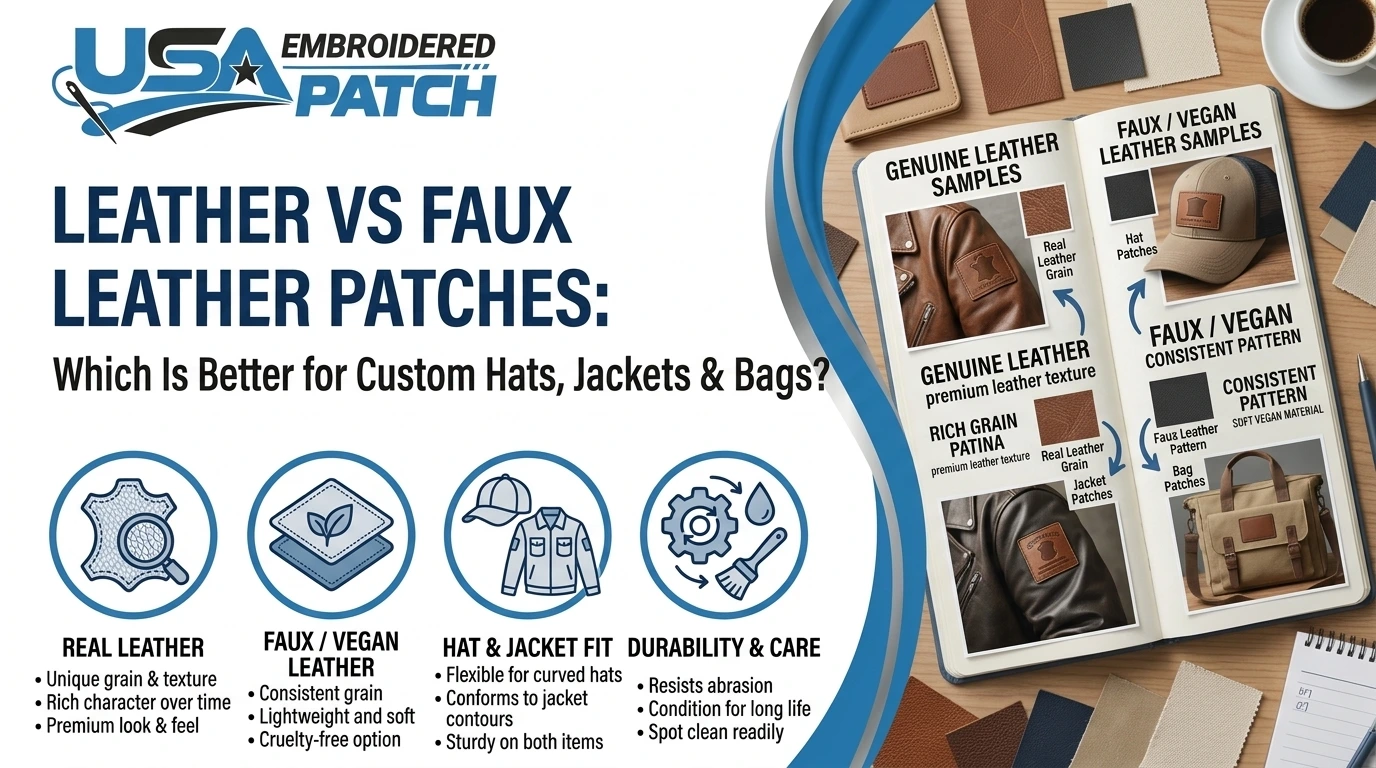
Choosing between real leather and synthetic leather can change how a custom patch looks, feels, and performs after months of use. Leather vs Faux Leather Patches is a comparison worth making before ordering branded hats, personalized jackets, or custom bags because the right material depends on more than appearance. Texture, engraving quality, flexibility, weather exposure, maintenance, and production costs all influence the final result.
When choosing a patch for a brand’s merchandise, merchandise business, or individual, the difficulty lies in picking out a patch that works well with the item without compromising its functionality and design. The material that works perfectly with a structured trucker hat will not necessarily work great with a flexible backpack or a frequently-fritioned jacket.
It would do business owners researching on the embroidered patch makers in USA to note that not all leather-like patches are embroidered. Depending on the material of the patch, companies can create the patches through engraving, embossing, printing, or stitching.
Here are some things to consider when selecting the appropriate material for your patch.
1. What Is the Actual Difference Between Real Leather and Faux Leather Patches?
Authentic leather is sourced from animal skin and has a natural grain that differs from piece to piece. These differences in grain create distinct characteristics in every patch and make genuine leather ideal for heritage wear, workwear, western hats, and premium accessories.
Fake leather is a man-made product intended to mimic authentic leather. It can feature a smooth, pebble-grained, matte, or textured finish, depending on its composition. Polyurethane (PU) is an example of a material that can be used to create fake leather surfaces.
The distinction can be made by comparing two patches with identical logos. Genuine leather patches will have slight differences in grain, while a faux leather alternative will give you a smoother finish for hundreds of pieces.
None of the materials automatically look better than the other one. An organic and slightly uneven texture may be perfect for a rustic clothing brand, while a synthetic finish will go well with modern streetwear.
Make sure to carefully examine your patch's texture, thickness, edge, and logo definition before placing the order.
2. Which Material Lasts Longer on Hats, Jackets, and Bags?
Neither real leather nor fake leather provides durability for sure. It will depend on the quality of the material itself, the way it is assembled, secured, exposed to natural elements, and the usage of the final product.
High-quality real leather can become beautiful with age and have a patina. Moisture, improper cleaning, and incorrect storage can affect the appearance and color of the material.
Fake leather can work perfectly for everyday use. At the same time, some coatings made of fake leather can deteriorate, crack, peel, or wear out after numerous bends and usage. It also depends on the material's quality.
Imagine a cap that is going to be used in the outdoor environment several times a week. A durable patch properly secured will last long. But numerous washes and improper cleaning can significantly reduce its lifespan. Another case is a backpack in which the patch will constantly rub against straps and clothes.
Consult your supplier about the material's elasticity and finishing. In case of high-demand products, ask for a sample.
The key takeaway: Compare the performance of the actual materials being offered instead of assuming that every genuine leather patch outlasts every synthetic alternative.
3. Are Genuine or Faux Leather Patches Better for Custom Hats?
The choice of the best patch that will be suitable for a hat should consider its structure, material used, design, and the target market of the wearer.
Leather is highly recommendable for use with trucker hats, snap backs, outdoor headgear, and workwear inspired hats. A brown leather patch with a mountain logo that has been engraved will go well with canvas front hats that have mesh sides.
Synthetic leather can offer the same look, and with a more even finish. This makes it ideal for use by firms making custom caps in a number of colors.
Thickness is crucial in choosing the material since too thick of a patch can make the cap rigid while too thin can result in the patch being too light for quality headgear. Fine lettering and small logos may not fit into too thin of patches.
Let us imagine that a firm wants 200 branded caps, in which each needs a black patch with a white logo. Here, synthetic material may be the best for use. A boutique selling limited edition outdoor hats may prefer genuine leather.
How you fix the patch to the hat is also crucial, sewing being the most appropriate for some caps.
Choose the combination that works for the complete hat, not just the patch sample.
4. Which Patch Material Works Best on Leather Jackets and Heavy Outerwear?
The jacket will be subject to bending on the shoulders and elbows, touching of other clothes and maybe even rain and sweat. The right patch should enhance the garment without interfering with its natural movement.
True leather can match tough denim jackets, work clothes, and high-end outerwear. Its inherent grain can be a good match for thick canvas fabric, dark denim, and authentic leather items.
Faux leather would be more appropriate for manufacturers who want a uniform look, particular colors or even the same appearance all through their collection.
For instance, a retro denim jacket can look great with a tan leather patch with an embossed logo on it. A contemporary black jacket can look great with a matte black faux leather patch with an engraved design.
In choosing custom patches for leather jackets, you need to consider the flexibility of the patch and how it will attach itself to the garment. A stiff patch will not be able to move freely and the wrong heat and adhesives will damage the finish of the garment.
Sewing can be considered for most jackets but the material and construction should allow it. The stitching holes can be hard to fix in authentic leather garments
If you are customizing finished jackets rather than manufacturing new ones, test the proposed attachment method on a suitable sample before approving production.
5. Can PU Leather Patches Match the Appearance of Genuine Leather?
Yes. PU leather patches are capable of producing many characteristics of genuine leather, including textures, smoothness and matte surface. It all depends on the quality of the material used and the process of production.
Polyurethane is a type of polymer, which is used in making a PU leather coating. Usually in such constructions, there is a supporting material under the coating.
It means that PU is quite a handy material for brands looking for repeatable colors and finishes. For instance, the company creating patches in tan, black, and dark brown color may find the use of synthetic material handy.
There are also possibilities of PU leather patches' engraving or embossing depending on the material and equipment of the manufacturer. But not all kinds of PU material behave equally to different types of finishes.
For instance, it is possible to produce clear reproduction of a logo with large letters and clear outlines. But if the logo contains small text and thin lines, more testing may be needed.
Remember that PU leather is one type of faux leather, not a synonym for every synthetic leather material. Faux leather products can use different constructions, so ask for the exact material specification before ordering.
Also, do not assume that PU is automatically waterproof, scratch-proof, or environmentally friendly. Those characteristics require product-specific evidence.
6. Which Material Is Easier to Clean and Maintain?
Patches also require maintenance when they are attached to items that are used regularly.
The authentic leather may need proper cleaning and application of leather care product, depending on its finish. The inappropriate cleaner or conditioner may affect its color and cause marks.
The faux leather may need nothing but a clean soft cloth and proper cleaning solution. Yet, harsh chemicals, hard scrubbing, and excessive heat may affect the protective layer of the faux leather.
Let us imagine that one has a baseball cap covered with sweat and dirt around its front patch. Inappropriate care of the hat without consulting the manufacturing instructions may ruin the patch, regardless of the durability of the material.
It is true for any bag or jacket as well. The fact that the patch is made of synthetic materials does not mean that the whole product may be washed in a washing machine.
Ask about the way of cleaning a patch and its compatibility with care instructions before you place an order. If the final product is supposed to be washed frequently, consider all the materials and methods of attachment together.
A material that looks attractive at delivery but requires unsuitable maintenance may not be the right choice for everyday use.
7. Are Custom Leather Patches Worth the Higher Initial Cost?
Patch cost is determined by the price of the patch, its expected longevity, quantity ordered, and the patch's functionality in the final product.
The actual leather will cost more than some faux leathers to purchase. Nevertheless, it may be used in creating a luxury product where the authentic feel and classic style appeal to the customers.
Faux leather might help companies in controlling costs while preserving the uniform look. This will be especially handy when it comes to promotional goods, branded hats, and extensive product lines.
Nevertheless, the material cost is not the sole factor that affects the price of an order. Such elements as the size of patches, their thickness, level of complexity, type of finishing, backing, stitching, minimum order quantities, and setups should be taken into account as well.
Imagine a company making clothing labels offering unique, limited edition jackets. The characteristic finish of the real leather might justify its expense in such case. Companies ordering several hundreds of uniforms' event bags will be interested in uniform colors and predictability of the production costs.
This makes it easier to compare genuine value rather than simply choosing the cheapest quote.
8. Is Genuine Leather or Faux Leather the More Responsible Choice?
The environmental impact of either depends on how it is made, utilized, and discarded.
Genuine leather comes from hides, and it can have an environmental impact through livestock rearing, tanning, consumption of water, chemicals, and manufacture. The source of genuine leather does not always mean that it is environmentally friendly.
Traditional fake leather usually contains synthetic polymers. PU leather does not contain animal hides, which might be a preferred option for those firms that do not want to use animal products, but it is not necessarily biodegradable or recyclable.
Sometimes there are materials that utilize recycled material or some other type of material in order to lessen specific impact on the environment. It all depends on the composition of the product and its justification.
Another important aspect is durability. The longer-lasting patch may lessen the need for replacements, although it all depends on the entire garment or accessory.
If sustainability is important to your brand, ask suppliers for material composition, recycled-content information, relevant certifications, and care guidance. Avoid relying on broad claims such as natural, eco-friendly, or vegan without checking what they mean for the specific product.
The most responsible decision is an informed one based on documented information, realistic product life, and the needs of your customers.
9. What Should You Ask a Patch Supplier Before Approving Your Order?
Choosing the material is only the first step. The final result also depends on how accurately the supplier reproduces your design and attaches the patch to the intended product.
Before placing an order, ask these questions:
What is the exact material? Confirm whether it is genuine leather, PU leather, or another synthetic material.
Can I review a sample? Check the color, surface texture, thickness, edges, and design clarity.
Which finishing methods are available? Confirm whether the material supports engraving, embossing, printing, embroidery, or another requested technique.
How will the patch attach? Check whether sewing, adhesive backing, or heat application suits the hat, jacket, or bag.
What will the complete order cost? Request details about minimum quantities, setup fees, samples, and shipping.
How should I maintain the finished product? Make sure the care instructions match its expected use.
If your logo includes small text or fine lines, request a design proof before production. What looks clear on a computer screen may not reproduce well on a small patch.
For larger orders, test the patch on the actual garment or accessory. Check its appearance under normal lighting, how it feels against the fabric, and whether the attachment remains secure during ordinary use.
When comparing embroidered patch makers in USA, verify which customization methods each supplier actually offers. A manufacturer specializing in embroidered fabric patches may have different capabilities from one producing engraved leather-style patches.
Clear specifications, a suitable sample, and written approval help reduce avoidable production mistakes.
Final Verdict: Which Is Better for Your Custom Product?
The best choice in the Leather vs Faux Leather Patches comparison depends on the look you want, the conditions your product will face, and the budget available.
Select genuine leather if authenticity, grain, texture, and natural finish are important. It may be considered an ideal choice for heritage-styled hats, high-end outerwear, and travel canvas bags.
Select faux leather if consistency, color selection, and flexibility of manufacturing are the most important factors to consider. Good-quality PU leather may be appropriate for branded merchandise, matching caps, and numerous types of accessories.
When selecting leather patches for customizing products, it is not only about the type of leather material. The thickness, design, mounting technique, exposure to moisture, and care required must be considered. Properly selected patches should enhance the product and remain appropriate for its intended application.
To avoid mistakes and select the right material and technique, compare samples and ensure that the materials and methods used are specified by the manufacturer before placing a large order. When purchasing patches for leather jackets, caps, and bags, consider the patch together with the entire product.
The smartest choice is the material that fits your design, use case, and quality expectations, not simply the one that costs less or looks more premium.