+1 226 4550-120
 info@usaembroideredpatch.com
Caring for Custom Embroidered Patches for Uniforms: Sizes, Backings, Name Patches & Ordering Tips
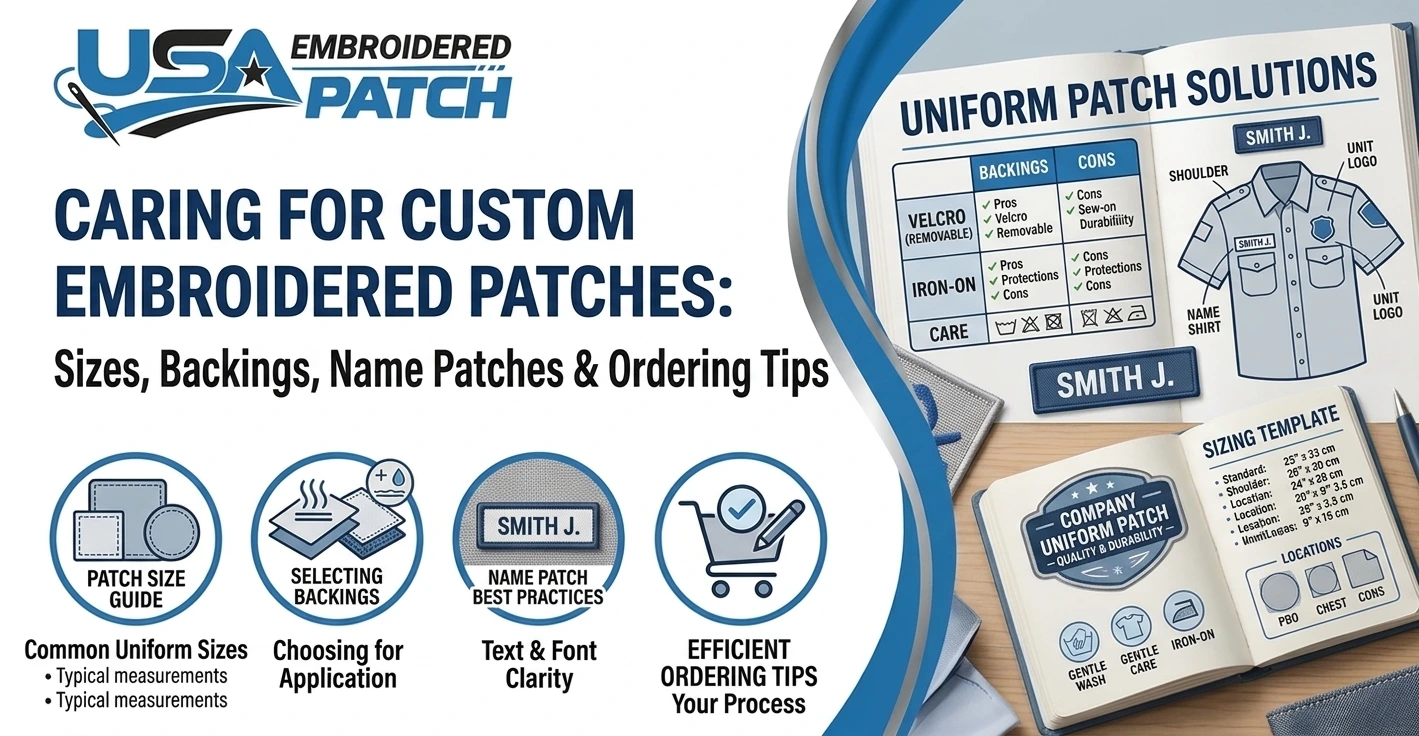
In addition to displaying a company's logo or worker's name, uniform patches provide uniformity among groups of workers, allow easy identification, and make uniforms look professionally done. However, when a patch begins to fray, its lettering becomes hard to decipher or it starts peeling off after being washed, even an excellent design quickly loses its neatness.
Selecting Custom Embroidered Patches for Uniforms means more than choosing colors and submitting artwork. It requires considering the patch size, material compatibility, its fastening method, and general care.
No matter what your needs are for patches, be it for your small business, educational institution, or even a big group of employees, this is how to select the best design and avoid ordering mistakes.
Why Embroidered Patches Are a Smart Choice for Uniforms
Embroidered patches offer a practical means of putting logos, names of employees, department names, and team insignias on uniforms. Rather than have all designs embroidered on clothing directly, companies can rely on separate patches to give them more freedom for future replacement of uniforms and changes in staff positions.
Consistency is another important point since uniform patches should match in colors and lettering.
However, embroidered patches can be made in a variety of forms ranging from rectangles to circles and even unique outlines. The durability of the patch will depend on the type of thread, backing material, attaching technique, fabric of the garment, and the conditions of cleaning.
What is more important is the balance between professionalism and practicality.
What Types of Uniform Embroidered Patches Suit Different Workplaces?
It all depends on the purpose you would like your patch to serve.
Logo patches: To display corporate logo, school logos, and team emblems.
Name patches: To display personal or professional names and titles.
Department patches: To aid in identifying different departments or tasks.
Badge patches: Applicable for organizations where there are defined badges.
Iron on embroidered patches: Applicable if the clothing material and the patch adhesive are compatible.
Sew on patches: Useful for everyday and washing clothes.
Removable patches: Used when identification panels should be replaced.
Custom Embroidered Patches can also be customized for various clothing types such as shirts, jackets, aprons and work clothing. Before making your choice on what kind of patch to use, think about how frequently you use the clothing and how often it is washed.
How Does the Embroidery of Patches Affect Quality?
Embroidered patches translate digital artwork into a stitched image. Factors that can influence how the final product depicts the artwork include the quality of the original artwork, stitching direction, number of stitches, and choice of colors.
For instance, an artwork that consists of a logo with big lettering may be simpler to reproduce compared to one with small lettering, outline, and fine details.
Some issues to consider before approving the production include the following:
Letter clarity: Ensure that names, position title, and any short message can still be read.
Stitch definition: The stitches should give a defined appearance but not make fine details look cluttered.
Color distinction: Use colors that can easily be distinguished from each other.
Edge finishing: Find out how the edges of the patches are finished to minimize fraying.
Artwork proof: The artwork proof should be evaluated at its final dimensions.
Where the logo has complicated details, inquire from the supplier whether it would be necessary to simplify the design.
Which Backing Is Best for Uniform Patches?
The backing will influence how the patch sticks to the uniform and if it is easy to remove. There are different backings, and the ideal one will depend on various factors.
If the uniforms are frequently washed, then sew-on backing is the more feasible option. However, iron-on embroidered patches offer a convenient way to speed things up, although the adhesive may be inappropriate for particular types of fabrics or washing procedures.
Always consider the recommendations provided on the label of the clothing or by the manufacturer of the patches. Never use heat if it can cause damage to the fabric.
What Patch Size, Placement, and Colors Make Uniforms Look Professional?
A patch that appears great on-screen might turn out to be either too big, too small or hard to read when applied to an actual piece of clothing. That is why all measurements should be taken according to the actual uniform.
Think about this while finzliing your design:
Check the placement area: Determine how much width and height you have and where other details like pockets and seams are.
Make it easy to read: Names and logos with too much information might require a bigger patch.
Place everything consistently: Always use the same placement for garments with identical styles.
Use contrasting colors: The names and logos should always be readable on the patch.
Keep proportions in mind: The design should fit the uniform well without being overwhelming.
Ask for a mock-up showing the proposed patch in full size. It will be easier to evaluate readability and placement.
What Uniform Patch Requirements Matter Across Different Industries?
Branding, Identification, and Durability Requirements Differ According to Different Workplaces.
Corporate Offices: Branding through logos and identification through names helps ensure consistent branding.
Educational Institutions: Use of emblems, house numbers, and clear wording aids in ensuring consistency.
Hospitality Services: Legible name patches and departmental identifiers will help customers identify the employees easily.
Industrial & Construction Environments: Attachment strength, readability, and fabric compatibility should be considered carefully.
Emergency Services & Security Services: The insignia, wording, and placement of patches might be regulated by policies of the organization.
Before purchasing, please ensure compliance with the requirements. Not all designs look good and follow organizational guidelines on uniforms.
How Should You Order Custom Embroidered Patches for Uniforms?
A good brief will save money by helping avoid mistakes and facilitate comparison of suppliers' quotes.
Have your artwork ready. Give your supplier an accurate logo or design, complete copy and brand colors.
Determine the dimensions and shape of your patch. Specify the exact final size, outline and location on the clothing.
Choose the kind of backing. Decide whether the patch should be sewn, heat applied or have the hook and loop fastener.
Calculate the number. Consider all staff, various departments and some allowance for replacements.
Ask for proof and estimate. Examine the proof for accuracy in layout, spelling and coloring, and check the cost, time and terms of delivery.
Approve the details of your order. If your patch is going to have names of employees, check the spelling of all the names very thoroughly.
Consider future opportunities for ordering patches. Ask about possibility of reordering the same design, colors and dimensions for new staff or uniform replacement.
How Can You Care for Embroidered Uniform Patches and Prevent Damage?
Proper care begins with adhering to the directions for washing of the fabric and further advice offered by the patch manufacturer. Various materials will behave in different ways to heat, detergents, and multiple washings.
Use these practical steps:
Care label guidelines should be adhered to: Ensure you know the washing and drying temperature recommended.
Wear garments inside out where possible: This will help protect the embroidery from the fabric rubbing against it.
Be careful about high temperatures: Some materials will be affected by very high temperatures.
Choose the right detergents: Follow the guidelines on the garment and do not use anything that could damage the fabric.
Monitor edges closely: Check for any signs of fraying, loosing stitching, or adhesive that might lift off.
Handle the issue of loose stitching: If detected early enough, it might save the patch from coming off.
Observe iron-on patch directions carefully: Do not use an iron without knowing the correct way to apply it.
If a patch gets damaged, then decide whether the patch needs repairing or replacement. Sewing a patch will leave needle marks, but peeling off an ironed-on patch will remove adhesive marks from the garment. Any method of cleaning or removal should first be tested on an inconspicuous part of the garment.
Frequently Asked Questions
1. How long does an embroidered patch last?
It varies greatly depending on thread quality, application, garment wear, washes, and maintenance. Good materials and proper application can assist in keeping patches good-looking, but there is not one definite lifespan for all uniforms.
2. Can an embroidered patch be washed in a machine?
Yes, it is possible for many embroidered patches to be machine-washed provided that the garment and the backing are suitable. Just follow the directions of washing and don’t wash patches in hot water.
3. Should I choose sewn-in patches or ironed-on patches for work uniforms?
It would be more appropriate to go for sewn-in patches if the uniforms are washed a lot or worn frequently. Iron-on patches can be useful for suitable fabrics but still depend on the glue, the process of applying, and washings.
4. What is the optimal size for a personalized name patch?
The optimal size allows fitting the whole name without loss of its readability while keeping the patch comfortable on the garment. Make sure you have measured your garment and see a mock-up of the patch at the real size.
5. Are damaged uniform patches replaceable?
Yes, for the most part. Patches that are sewn on can usually be unsewn and replaced, though unseing leaves needle holes. Patches that have an iron-on adhesive back can be harder to remove in good condition.
6. Is it possible to put company logo and name on a single patch?
Yes, it is. However, such a combination requires sufficient space for clear text and logo.
7. What can I do to prevent embroidered patches from fraying?
Choose right edge finish, ensure correct patch application, observe washing instructions, and keep an eye on edges. Trim loose threads with care without cutting adjacent embroidery, and fix loose stitching immediately.
8. What should I consider before ordering patches wholesale?
Artwork, dimensions, spelling, coloring, backing, number of pieces, proof approval, price, production time, and delivery terms are some of things to look into before making an order. Consider your reordering needs as well.
9. Are uniform patches reusable in case of a change in position by the same employee?
Patches attached using hook-and-loop technology are intended for multiple times of being removed. As for sew-on and iron-on patches, they may be more difficult to remove without damaging either the patch itself or the garment.
Final Thoughts
It is important that the ideal patch will be easily identifiable, appropriate for the uniform, and simple to care for. Making proper decisions on such aspects as embroidery, sizing, backing, and location of the patch can ensure avoidance of any unnecessary difficulties, whereas regular checking and proper cleaning can increase the longevity of the patch.
When ordering patches, one needs to examine the design in its true size, the way of attaching the patch, and the care instructions of the supplier.
Need to order the next uniforms for your team? Take a look at Custom Embroidered Patches for Uniforms and see the possibilities of design, sizes, backings, and name patches. Make sure you have the mock-up and your specifications confirmed before making the patch.